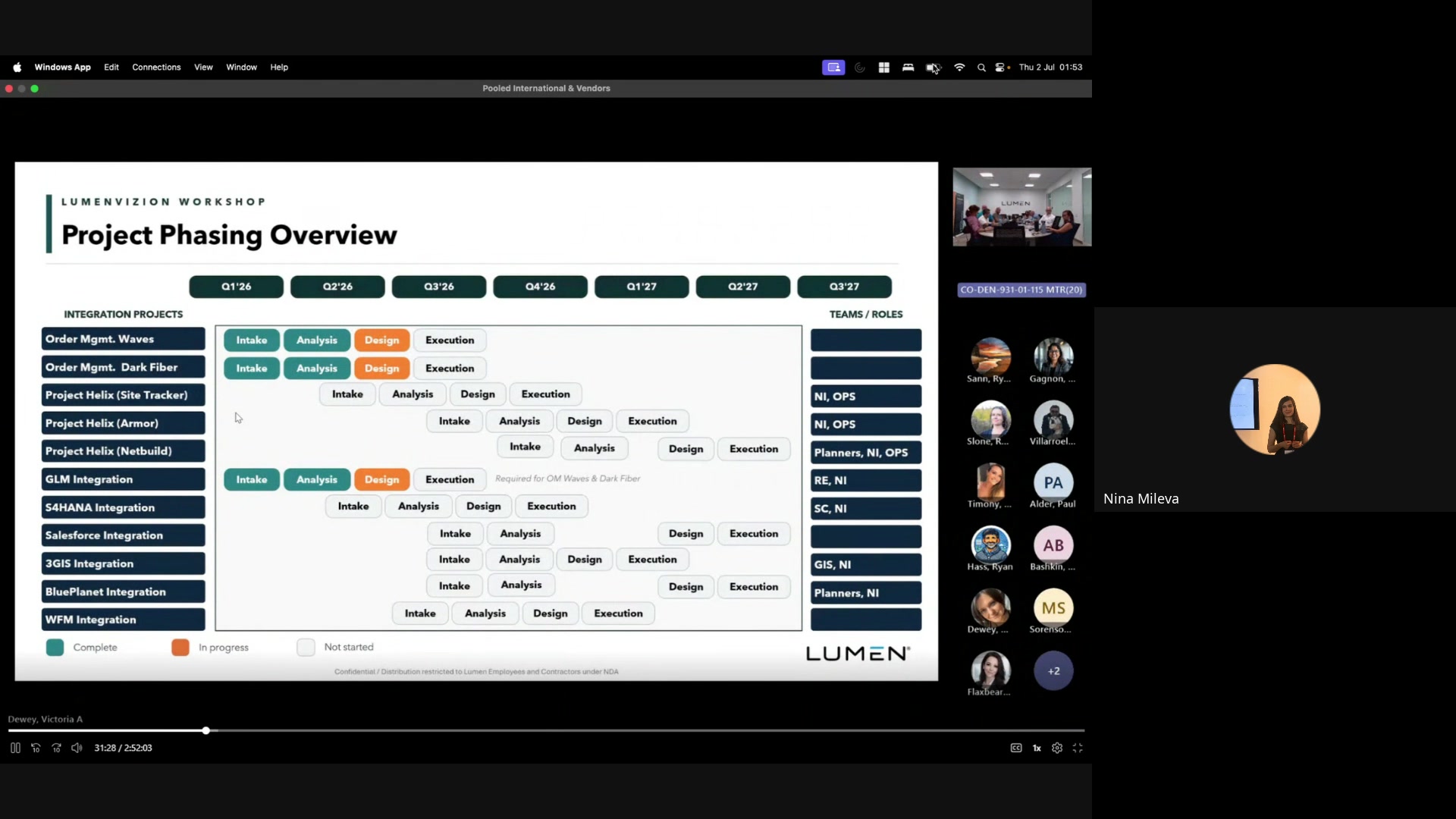
Architecture Commit Slide Outline
Purpose: 5-7 slide meeting narrative for the Architecture Commit discussion. This is not a polished deck; it is the content structure and speaking notes you can use to build or present slides.
Slide 1: Architecture Commit Objective
**Message**
We are not approving a single-tool replacement. We are committing to a staged architecture for network implementation transformation across workflow, orders, inventory, field work, procurement, reporting, and AI-enabled automation.
**Key Points**
- Lumen Vision / OneVision is the structured workflow and orchestration surface.
- Authoritative ownership remains distributed across Salesforce/NEO, SOM/BlueSteel, BPI, SAP S/4HANA, GLM/3GIS, BluePlanet, WFM, and reporting systems.
- The commit should approve boundaries, Release 1 scope, integration patterns, and unresolved decisions.
**Decision Needed**
- Confirm the architecture commit scope: conceptual target, Release 1 architecture, integration design, or delivery-ready plan.
**Speaking Note**
“My recommendation is to commit to system boundaries and release sequencing, not to imply that Lumen Vision becomes source of truth for every object on day one.”
Slide 2: Target Architecture Pattern
**Message**
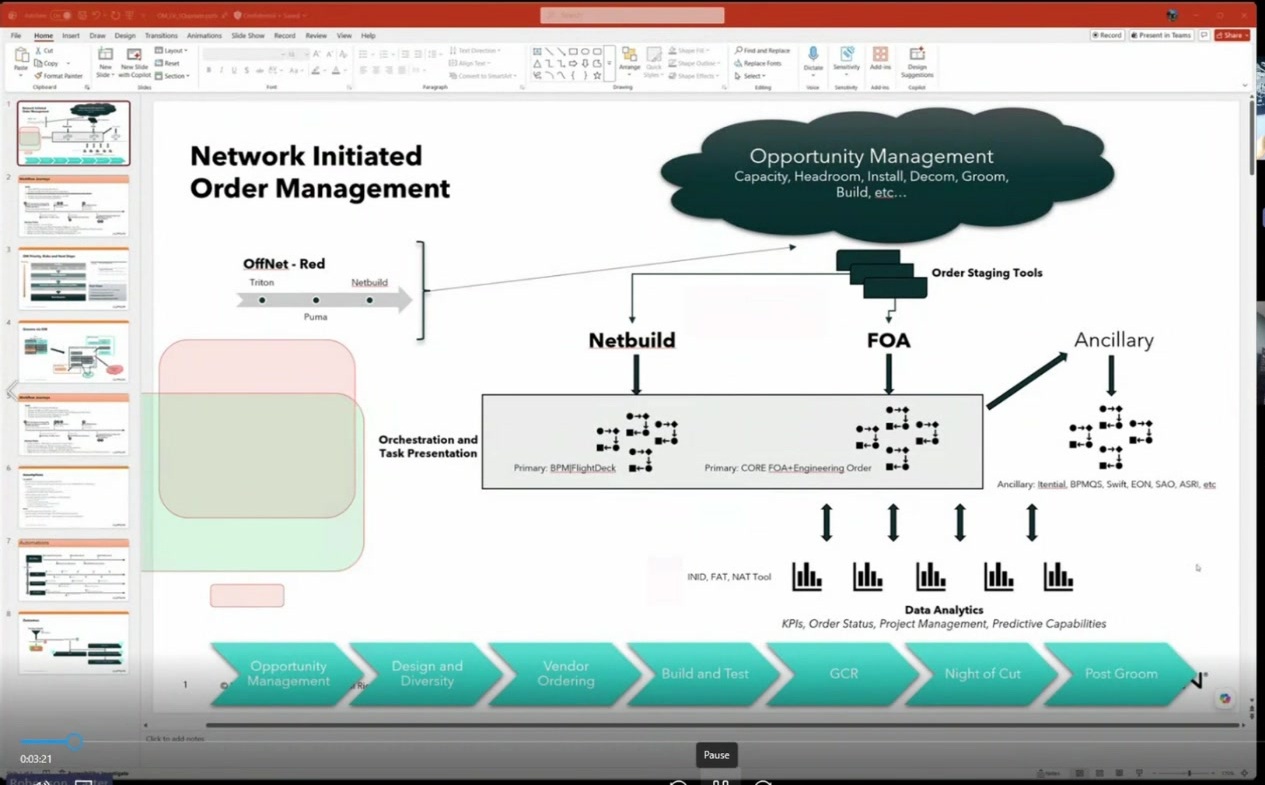
The target pattern is layered: source systems own authoritative state, Lumen Vision manages workflow experience/orchestration, Kafka/CFKA connects state changes, and Data Hub/reporting provide consolidated visibility.
**Architecture Layers**
- Source systems of record:
- Salesforce/NEO for product order.
- SOM/BlueSteel for service-order flow.
- BPI/Network systems for network orders.
- SAP S/4HANA for material master, procurement, capital/funding.
- GLM/3GIS/BluePlanet for location, route, network inventory.
- WFM/SFS/Flight Deck for selected field/task execution.
- Workflow and orchestration:
- Lumen Vision / OneVision.
- Itential, Flight Deck, ByFrost where delegated or transitional.
- Integration/eventing:
- Kafka/CFKA, source APIs, stitched read views, external gates.
- Visibility and intelligence:
- Data Hub, INID/reporting, dashboards, AI/ADO.
**Decision Needed**
- Agree that ownership is object-specific and workflow-specific.
**Supporting Artifacts**
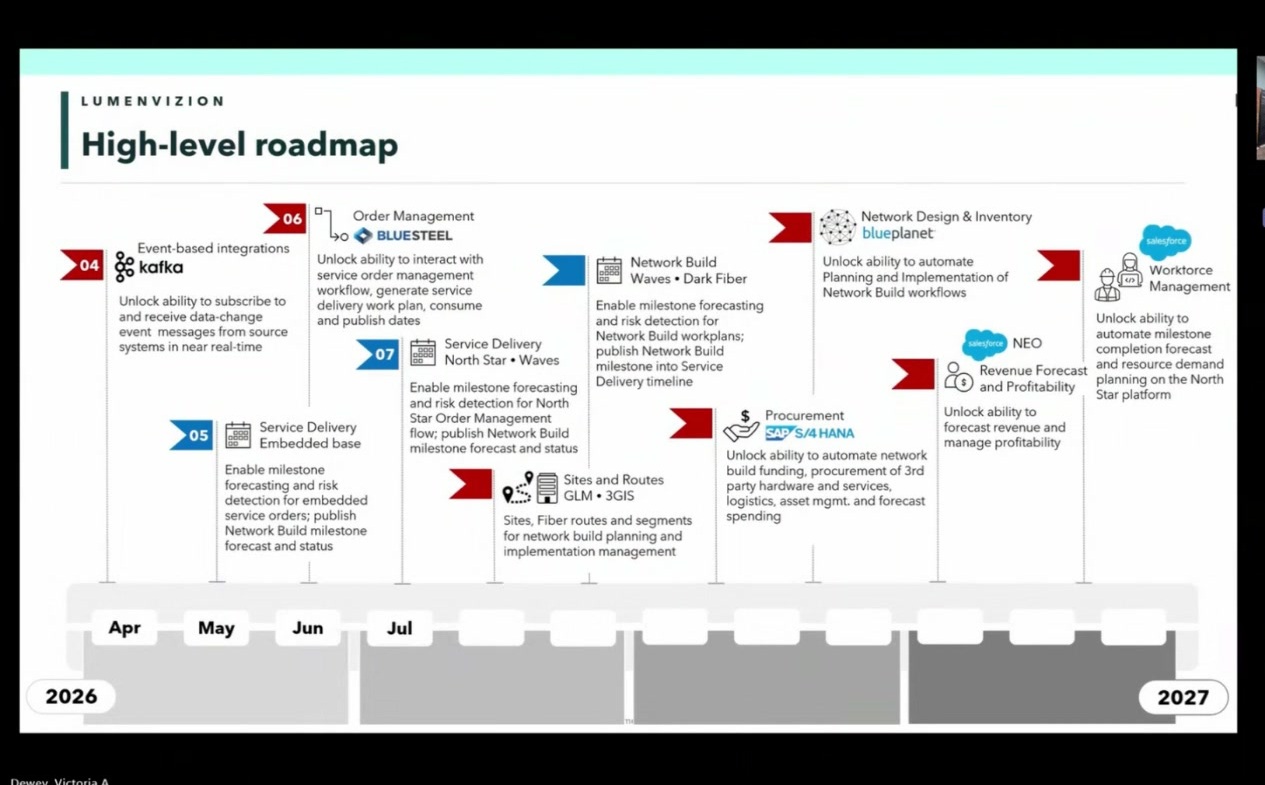
Slide 3: Release 1 Recommended Scope
**Message**
Release 1 should focus on the minimum integrations and ownership decisions needed to make the first workflows real and traceable.
**Recommended Release 1**
- Salesforce/NEO/SOM order events into Lumen Vision.
- Kafka 2.0 traceability headers for SOM 2.0.
- Lumen Vision to/from BPI for network order/design request visibility.
- Lumen Vision to/from Flight Deck or WFM for selected task/status sync.
- Data-cleanse external milestone gate in Lumen Vision.
- Read-only Data Hub stitched view for consumers.
- SiteTracker cutover/migration feed for net-new and selected active projects.
**Explicitly Defer / Constrain**
- Full BluePlanet write integration.
- Fully automated forecasting.
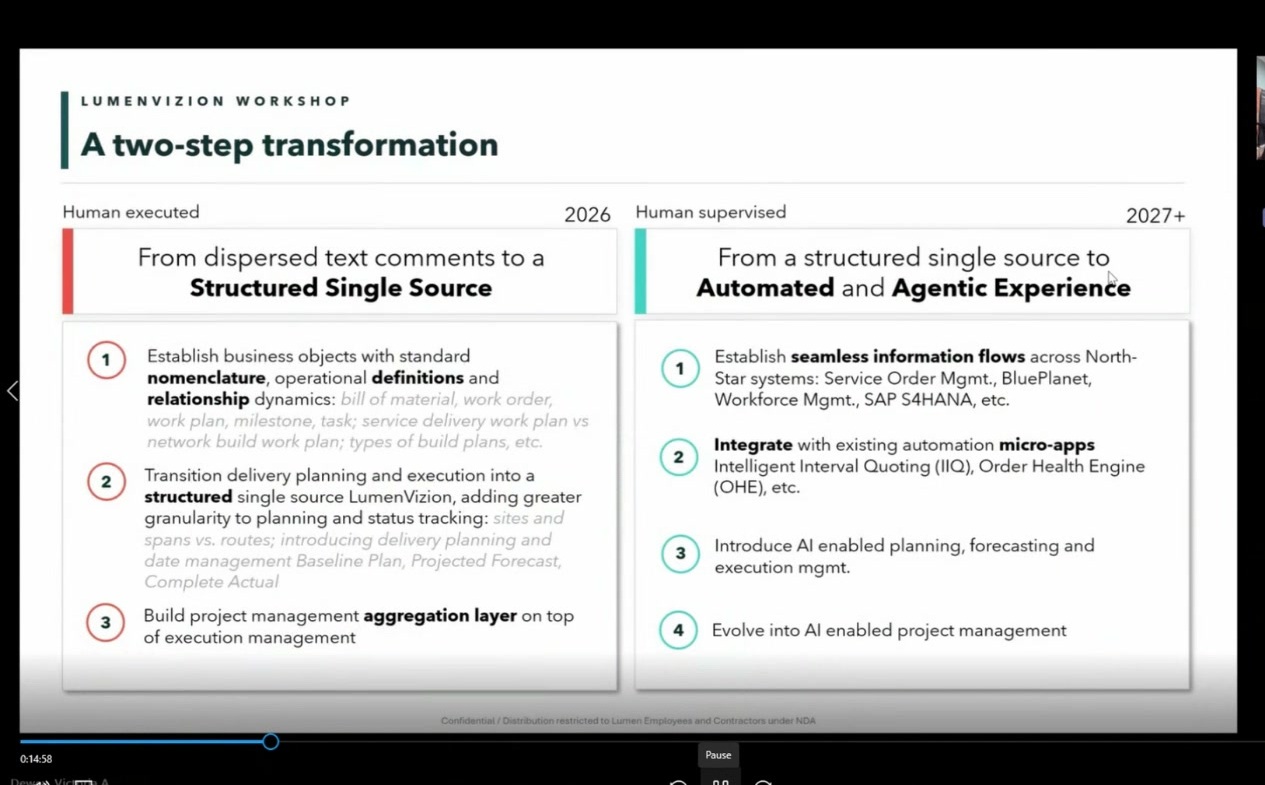
- Agentic AI execution without human approval.
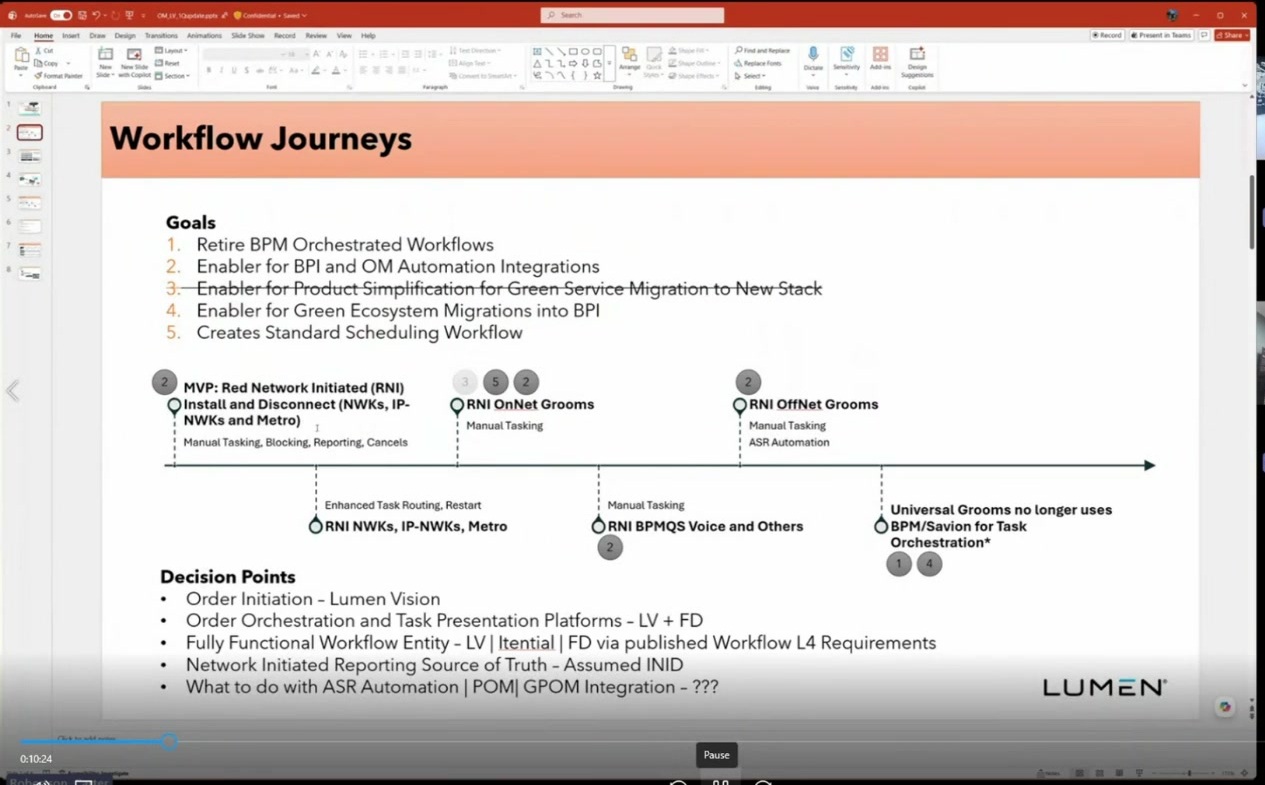
- Universal grooms migration.
- Broad partner live integrations before security/legal/data contracts are settled.
**Decision Needed**
- Confirm Release 1 workflow scope and deferred scope.
Slide 4: Decisions Required Before Commit
**Message**
The architecture can move forward if the committee resolves a small set of ownership and integration decisions.
**Decision Set**
| Decision | Why It Matters |
|---|---|
| Product/service/network order ownership | Defines end-to-end order flow |
| Task lifecycle ownership | Determines no-swivel feasibility |
| Workflow execution owner: LV / Itential / FD | Prevents duplicated orchestration |
| Kafka traceability header standard | Required for SOM 2.0 and observability |
| Date ownership model | Prevents forecasting and reporting conflicts |
| Data-cleanse gate model | Prevents network work from starting with bad data |
| SiteTracker/Armor/Netbuild cutover rules | Controls Project Helix migration risk |
| AI recommendation/action boundary | Prevents unsafe automation commitment |
**Decision Needed**
- Assign owners and due dates for each unresolved decision.
**Supporting Artifact**
- Decision matrix in architecture-commit-prep-pack.html
Slide 5: Integration Model
**Message**
The integration model should use a small number of repeatable patterns rather than one-off connections.
**Patterns**
- Event Publish/Subscribe for state changes and CDC.
- Source API Command for authorized updates to authoritative systems.
- Stitched Read View for consolidated visibility.
- External Milestone Gate for data cleanse, site survey, external permit states.
- Context Package for ByFrost/field execution support.
- Embedded UI only as a transitional no-swivel pattern.
- Manual Bridge / Flat File only as time-boxed exception.
**Commit Guardrails**
- Every integration needs an owner, object/event name, payload schema, correlation ID, replay/idempotency model, error handling, security model, and test environment.
- Data Hub is read-side only; updates go to source systems.
- Kafka/CFKA headers should be treated as shared architecture, not local implementation detail.
**Decision Needed**
- Approve integration pattern catalog and require each Release 1 integration to map to one pattern.
Slide 6: Risks And Mitigations
**Message**
The main risks are not just technical. They are ownership ambiguity, migration scope, data quality, and delivery readiness.
**Top Risks**
| Risk | Mitigation |
|---|---|
| Tool-first architecture | Use object ownership matrix |
| Hidden integration enablers | Track Kafka headers, CDC, replay, DLQ as backlog items |
| SiteTracker scope creep | Separate deadline migration from future transformation |
| AI overcommitment | Keep human approval until governance/data foundation is proven |
| Date inconsistency | Define canonical baseline/forecast/actual/need-by ownership |
| Task ambiguity | Define lifecycle and write-back contracts |
| Reporting mismatch | Confirm INID/Data Hub/LV reporting model |
| Environment weakness | Commit integration/UAT/pre-prod/rollback model |
**Decision Needed**
- Confirm these as architecture risks and track mitigation owners.
Slide 7: Ask / Approval
**Message**
Approve a staged architecture commitment with clear boundaries, not a broad promise that every workflow and integration is solved.
**Approval Ask**
Approve:
- Lumen Vision as structured workflow/orchestration surface for agreed Release 1 scope.
- Distributed source-of-truth model by object.
- Kafka/CFKA eventing and traceability as shared integration foundation.
- External gates for data cleanse and other non-LV prerequisite processes.
- Hybrid migration approach for SiteTracker/Armor/Netbuild exits.
- Human-supervised AI/ADO until data lineage, auditability, rollback/replay, and governance are proven.
Assign follow-ups:
- Object ownership validation.
- Release 1 integration contracts.
- Kafka 2.0 header standard.
- Date ownership model.
- Cutover/migration rules.
- Environment and rollback readiness.
**Closing Line**
“This lets us move forward with a credible architecture while keeping the unresolved ownership and integration questions visible instead of burying them inside delivery.”
Backup Slides
Backup A: System Of Record Heatmap
Use rows from system-of-record-matrix.html, grouped by:
- Confirmed.
- Likely.
- Open.
Backup B: Priority Integrations
Use P0/P1/P2 rows from integration-inventory.html.
Backup C: Visual Evidence
Use key screenshots from: